1
No source code to port
The deliverable is a swarm, not a rewrite. No line-by-line migration; custom design of specialized agents.
Our ATLAS-Agentic methodology adapts the ATLAS Legacy framework (10 code-modernization steps) to the agent swarm context. It keeps the key ATLAS principles (kill/go gates, proven parity, observed-behavior register) by transposing them to AI non-determinism and agentic security.
The deliverable is a swarm, not a rewrite. No line-by-line migration; custom design of specialized agents.
Parity is defined as human-agreement rate on double-run, not deterministic line-by-line parity like in ATLAS Legacy.
ZSP, JIT access, reverse offensive audit, multi-tenancy isolation — new classes of risk requiring a dedicated framework.
Delivery is not an end but a continuous operations mode — mandatory quarterly recertification, 24/7 observability.
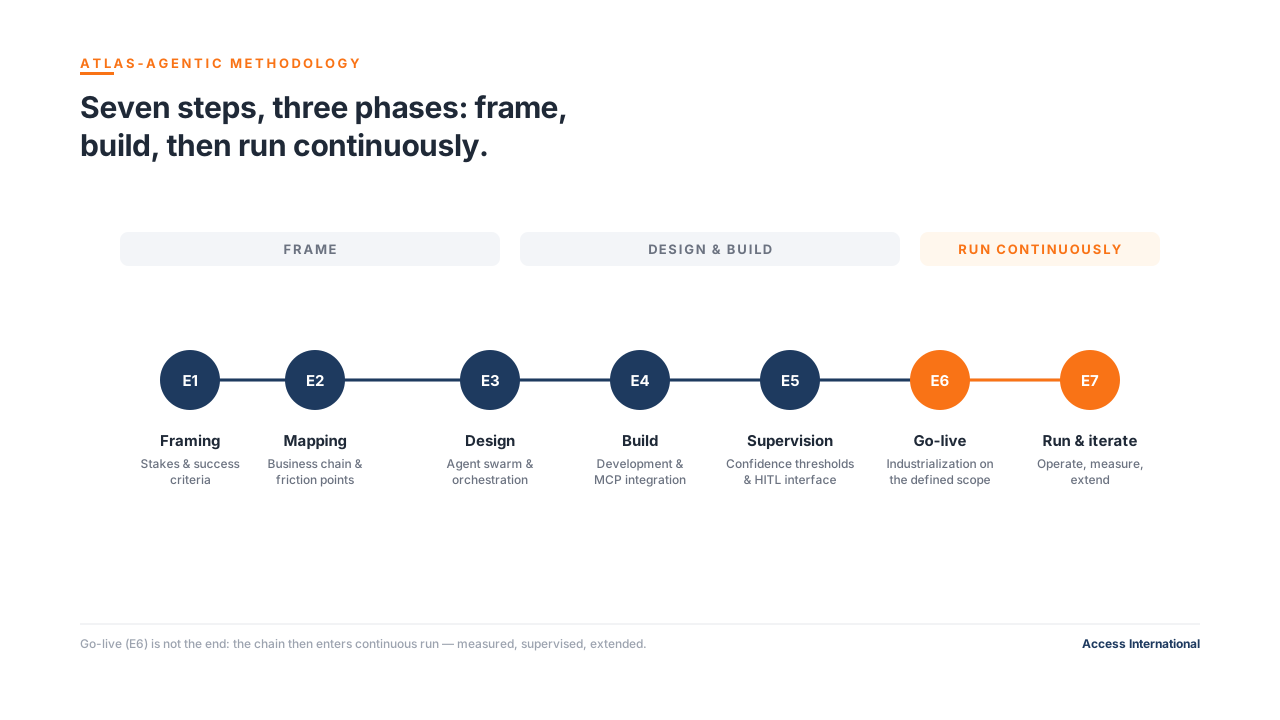
ObjectiveScope the perimeter, identify candidate processes, set success criteria and constraints (data, security, compliance, budget, schedule).
Exit gateBusiness + IT + security + finance alignment on the criteria.
ObjectiveDeeply understand the selected processes. Map data sources, tools, humans involved, explicit and implicit business rules.
Exit gateSource volume and quality validate feasibility.
ObjectivePrecisely identify which MCP connectors will be reused, which need adaptation, which created. Specify interface contracts.
Exit gateSufficient MCP coverage. If too much custom, replan or pivot.
ObjectiveDesign the agent swarm that will deliver value. Choose LLMs (vendor-neutral 'it depends'), define agents and their roles, specify guardrails and selective supervision policy.
Exit gateInternal Access architecture review + client review.
ObjectiveDevelop the swarm per E4 architecture. Short iterations with client demos. Per-agent unit tests, integration tests on the swarm.
Exit gateClient demos OK + integration tests passing + internal security review.
ObjectiveRun the swarm on real data in parallel with humans on a representative sample. Measure agreement rate, identify divergences, tune guardrails.
Exit gateAgreement rate ≥ E1 threshold + zero critical vulnerability + DPO sign-off.
ObjectiveShip the swarm to production in supervised mode then progressively autonomous. Transfer skills to human orchestrator. Set up continuous observability.
Exit gateValidated runbook + trained orchestrator + operational observability + approved recertification plan.
Rewritten code
Agent swarm
Deterministic line-by-line
Statistical double-run agreement rate
Classical audit
ZSP + JIT + reverse offensive audit
One-shot cutover
Progressive go-live + continuous operations
Not standardized
Mandatory quarterly
Technology target fixed at E4
Substitutable LLM, vendor-neutral
Four specificities require a variant: no code to port (deliverable = swarm), intrinsic LLM non-determinism (statistical parity not line-by-line), radically different security (ZSP / JIT / reverse offensive audit), continuous loop (delivery is not an end but an operations mode). ATLAS-Agentic keeps the key ATLAS principles (kill/go gates, discrepancy register) by adapting them.
From E1 to go-live (E7): 4 to 7 months depending on complexity. E1 Intake 2-4 weeks, E2 Discovery 3-6 weeks, E3 MCP 2-3 weeks, E4 Architecture 3-5 weeks, E5 Build 6-16 weeks, E6 Validation 4-8 weeks, E7 Delivery 2-4 weeks + ongoing operations. The most variable phase is E5 depending on swarm complexity (3-10 agents typical).
Agentic equivalent of the ATLAS Legacy discrepancy register. Every swarm / human divergence is tracked during E6 Supervised validation and continuously in E7. Each entry is analyzed and classified: acceptable (normal variability), to fix (tune guardrail / prompt), to escalate to human (case systematically routed up). Industrializes continuous improvement.
The E6 → E7 gate does not open. Three options: iterate on guardrails and prompts to improve the rate, broaden the selective supervision policy (more cases routed to humans), or pivot the scope (remove a too-complex process). No go-live until the gate is crossed.
At every major LLM update used, or every three months minimum, the swarm is revalidated on the reference test set (from E6). If the agreement rate drops below threshold, the swarm automatically falls back to degraded mode (humans only) until corrected. Prevents silent drift.
Yes, often. Legacy modernization + agentic swarm deployment on the modernized system. ATLAS Legacy delivers the technical foundation (Java, .NET, TypeScript), ATLAS-Agentic delivers the intelligent orchestration layer on top. The two methodologies chain together, with shared gates on critical junctions.
4 weeks of E1 scoping to identify the process to entrust to a swarm, measure expected ROI, and price the full program.