Loading...
Nearshore & offshore
Nearshore Tunisia: the quality/price ratio that changes the equation
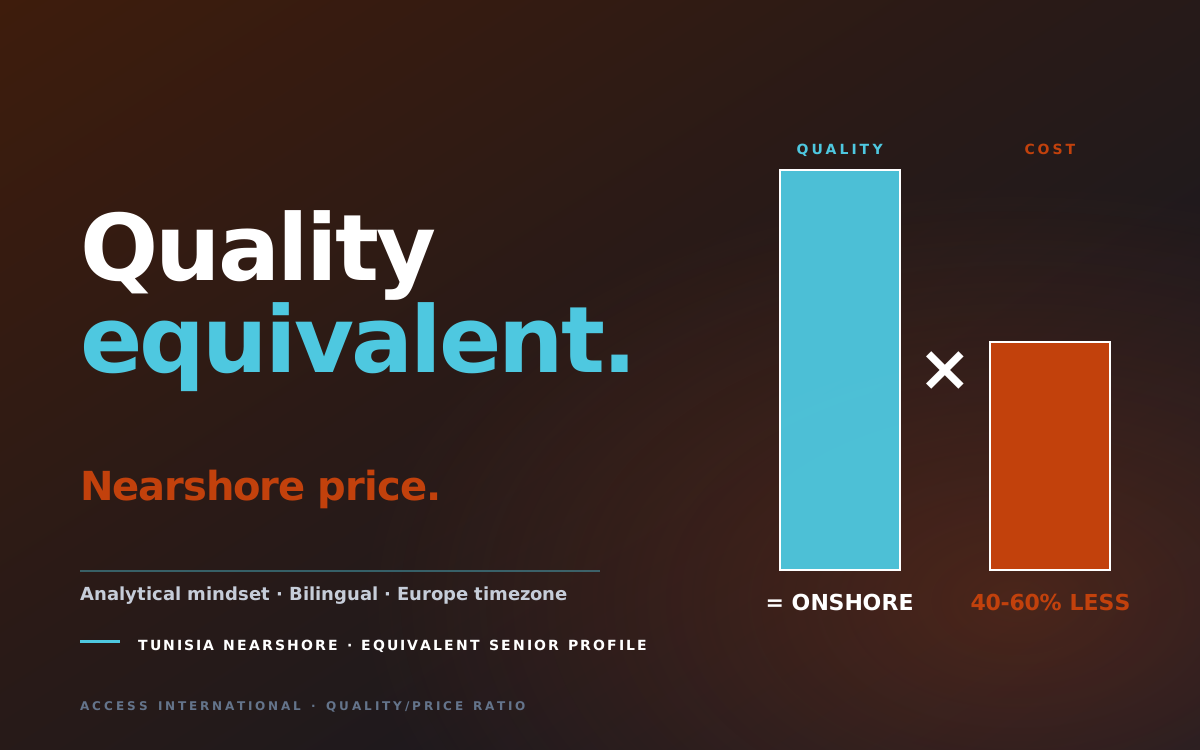
Tunisian nearshore is recognized for a quality/price ratio that few equivalent talent pools achieve. 40 to 60% below onshore Europe rates at equivalent senior profile, with an analytical mindset of engineers that changes the equation on legacy modernization projects.
Nearshore · 5 min·5 minute read

Co-founder · Managing Partner
10,000
IT engineers graduating per year
40-60%
below onshore Europe at equal profile
4-6 weeks
staffing of a 20-engineer team
The Tunisian IT pool: a rare density
Tunisia trains about ten thousand IT engineers each year, from recognized schools (ENIT, ENSI, INSAT, SUP'COM, Esprit, Polytechnique). The country concentrates more than 1,200 ICT companies, development centers of international groups (Alcatel, Valeo, Sofrecom, Teleperformance), and a university ecosystem structured around 50 institutions.
This density translates concretely: to set up a nearshore cell of around 20 engineers on a multi-year engagement of three years minimum, staffing times are 4 to 6 weeks, not several months as in overloaded European onshore consulting firms. For a fixed-price project with framed deliverables, the cell is sized to the right scope.
Consultants move from one technology to another fluidly (COBOL and Java, Delphi and .NET, ServiceNow and Dynamics). The professional ecosystem is structured by bodies (TACT, Smart Tunisia, APII) and supported by 20 years of IT services exports to Europe.
Analytical mindset: the real differentiator
On legacy modernization projects, understanding existing code is harder than rewriting it. Business rules accumulate over decades, without exhaustive documentation, in languages whose expertise becomes scarce on the market.
Tunisian engineers are trained in rigorous functional modeling from the first year of engineering school. This discipline translates into better requirements qualification upstream, less ambiguity in produced specifications, and reasoned technical decisions rather than improvised ones.
On a COBOL to Java migration program, the Discovery phase — where we understand what the existing code really does — is often the longest and most critical. An engineer trained in functional analysis produces far superior Discovery quality, as documented in our ATLAS methodology.
Positioning vs other nearshore pools
Common alternatives to onshore services are India, Poland, Morocco, and Madagascar. Each has its strengths and limits.
India offers an unbeatable rate but a 5 to 9 hour time difference with Europe, and high talent rotation. Poland has excellent technical level but rates that quickly converge with the European market. Madagascar has native French but fewer senior IT engineers available. Morocco offers a good balance but with a smaller pool depth.
Tunisia offers a hard-to-beat compromise: native French, native English, European time zone, ten thousand engineers per year, and rates 40 to 60% below onshore Paris or Montreal. For a Francophone client demanding on quality and price, the Tunisian pool dominates.
Economic logic: what do we do with the margin?
At equivalent senior profile with 10 to 12 years of experience, a Tunis nearshore consultant costs 40 to 60% less than an onshore Paris or Montreal consultant. The gap is absorbed by the local cost structure (salaries, charges, real estate, taxation), not by profile quality nor engagement depth.
The margin generated is not pure savings. It allows the client to fund more regression tests, more documentation, more exploratory POCs, more skills transfer to the internal team. The delivered program — whether in time and materials or fixed price — is often more robust than an onshore program at the same budget.
This is what we call the recognized quality/price ratio: it's not just cheaper, it's better invested.
Time zone: an asset for Europe and Canada
Tunis is in UTC+1 year-round, with no seasonal time change. The gap with Paris, Brussels, or Geneva is 0 or +1 hour depending on the season. Working days overlap almost entirely with those of European clients.
For Canadian clients, the gap is -5 to -6 hours depending on the season. Tunis teams end their day around 5-6 PM local time, when Montreal or Toronto teams start theirs. This natural handoff enables an effective follow-the-sun model without requiring night teams.
For the Middle East (Riyadh, Dubai), the gap is +2 hours, which remains comfortable for daily meetings.
Frequently asked questions
What decision-makers ask about this topic.
How does Access recruit and retain senior engineers?+
Internal pool of 100+ consultants with high average tenure. Pre-qualified freelance pool. Continuous training programs (Microsoft, ServiceNow, AWS, Databricks certifications). Competitive compensation on the local Tunisian market.
What engagement models does Access offer?+
Four models depending on the desired autonomy level: Staff Augmentation (consultants on time and materials), Development Center (dedicated cell on fixed price or means), Competency Center (pooled expertise), Service Center (24/7 with SLA). Fixed-price transformation projects are possible, as are multi-year engagements (3-year minimum) on a development center. Details on the Delivery models page.
What minimum engagement duration for a nearshore development center?+
For a dedicated nearshore cell operating over several years, we recommend a contractual minimum engagement of three years. This duration stabilizes the team, industrializes the relationship, and delivers a solid return on investment. For ad hoc needs or framed deliverables, fixed-price projects are offered without this constraint.
Does the Tunisian regulatory framework allow IT export to the EU and Canada?+
Yes, structured for over 20 years: contracting in foreign currencies (EUR, USD, CAD), compliant invoicing, immaterial customs, export accounting. For personal data subject to GDPR or Quebec Bill 25, regional hosting (Azure France Central, Azure Canada Central) with tenant isolation.
How does Access manage service continuity over several years?+
Consultant rotation below sector averages. Program governance with systematic backup on key profiles, up-to-date documentation, written transition plan. A departure never puts a project on pause.
Why Tunisia rather than Poland or Morocco?+
Tunisia offers the best compromise of native French + cost + analytical mindset. Poland is more expensive at equivalent quality. Morocco has the French advantage but fewer senior IT engineers available. For demanding Francophone clients on quality and price, Tunisia dominates.
Does your program match this case?
We frame every program at Intake, with transparent budgeting. A short POC of a few weeks can be delivered before committing to the full program.
Get a nearshore quote →