AI orchestration and governance

AI orchestration and governance — connect your systems, keep humans in the loop.

Four delivered products around agentic orchestration: chains of specialized agents running in production every day, industrial HITL framework, sector orchestration layers (tourism, banking). Open MCP architecture, selective human supervision, vendor-neutral. The promise is not multi-agent magic — it is the discipline of a chain that runs, with decision logging, source allowlist, and FinOps governance.

Four orchestration products delivered in production

Each is industrialized. Two already run at our clients (think tank MENA agentic workflows, French telecom HITL Framework). The other two are ready for first sector deployment (tourism, banking).

10
In progress / available

AI Tourism Orchestration — Dynamic workflows on client log analysis

The right message, to the right visitor, at the right time. Dynamic workflows triggered by deep client log analysis.

AI orchestration layer for national or regional tourism ecosystems. Connects destination CRMs, hotel Property Management Systems, airline reservation systems, and analytics. Goes beyond communication orchestration: deep client log analysis (past stays, preferences, behaviors, signals) and dynamic workflow triggering (complementary booking, upsell, room transfer, local recommendation). Delivers the right contextual action at each step of the journey.

Key features
  • Integration layer between destination CRMs, hotel PMSs, airline GDSs, analytics
  • Deep client log analysis (stay history, preferences, behaviors, intent signals)
  • Dynamic workflows triggered by contextual analysis (not just static rules)
  • AI orchestration for personalization and smart upsell
  • Real-time silo connection (booking, loyalty, preferences, cultural intentions)
Technologies

MCP (Model Context Protocol), LLM, log analysis and contextual scoring engine, CRM, PMS, GDS, data warehouse integrations.

15
Delivered

HITL Framework — Human validation loop for AI

Keep humans in the decision on critical cases, at scale.

Industrial Human-in-the-Loop framework: human validation interface on AI outputs, case queue to arbitrate, confidence scoring, human/AI agreement metrics, continuous learning from corrections.

Key features
  • Validation interface designed for production rhythm
  • Case queue prioritized by criticality and AI uncertainty
  • Confidence scoring and configurable thresholds
  • Continuous learning from human corrections
  • Human/AI agreement metrics and quality reporting
Technologies

React frontend, queue management, LLM integration, real-time metrics, EU AI Act compliance.

18
In progress / available

AI Banking Orchestration — Dynamic workflows on client log

Deep banking client log analysis, contextual workflow triggering: product reco, fraud alert, credit opportunity, complaint management.

AI orchestration layer for banking players: deep client log analysis (transactions, interactions, life events, risk signals) and dynamic contextualized workflow triggering. Product recommendation (savings, credit, insurance) at the right time, fraud alert based on behavior deviation, contextual complaint management, upsell or cross-sell opportunity at the opportune moment. Designed for strict regulatory compliance (KYC, GDPR, banking secrecy, AML).

Key features
  • Deep client log analysis (transactions, interactions, behaviors, signals)
  • Dynamic workflows triggered by contextual analysis (not just static rules)
  • Contextual financial product recommendations (savings, credit, insurance, investment)
  • Real-time anomaly and fraud signal detection
  • Contextual complaint management with full client history access
Technologies

MCP (Model Context Protocol), LLM, log analysis and contextual scoring engine, core banking, CRM, fraud detection, data warehouse integrations.

23
Delivered

Agentic workflows — Multi-agent AI orchestration in production

Run multiple specialized AI agents together, on real business task chains — without breakage and without rogue agents.

Design and operation of agentic workflow chains: several specialized AI agents (research, writing, validation, publishing) coordinated around explicit orchestration (n8n, Airflow, custom). The promise is not multi-agent magic: it is the **discipline of a chain that runs in production every day**, with human checkpoints, decision logging, source allowlists, and inference-cost governance. Validated in production on a real Middle-East economic think-tank case since late 2025.

Key features
  • Explicit agentic chain design (no opaque auto-orchestration): every step declared, every LLM call traced, every transition documented
  • n8n stack (recommended), Airflow, or custom orchestration on Cloudflare Workers / Node depending on client constraints
  • Task-specialized agents (sourced web research, long-form writing, factual validation, CMS publishing, Gamma slide generation) rather than autonomous generalist agent
  • Configurable human checkpoints (HITL) on risky steps: final publish, spend > threshold, source allowlist exit
  • Source allowlist and complete decision logging: we know why an agent chose this source, this phrasing, this action
Technologies

n8n self-hosted or cloud (default recommendation), alternatively Airflow or custom orchestration. Mixed LLM per step: Claude (long-form writing, reasoning), OpenAI GPT-4o (multi-modality, speed), open-source models via Groq for non-critical steps. WordPress, Gamma, Notion, Google Workspace connectors, business APIs.
Concrete use cases

Three operational chains, three contexts.

Anonymized per client preferences. Ask for access to detailed files under NDA.

Economic think tank — MENA

Five agentic workflows in production every day

Orchestrated editorial chain: agents specialized in sourced research, long-form writing, factual validation, newsletter generation, and CMS publishing. More than 140 articles auto-generated and published on a public portal since late 2025. Source allowlist, parameterable human checkpoints, multi-LLM FinOps governance.

In production
Telecom operator — France

HITL supervised qualification platform in production

Industrial human loop on NLP outputs: queue prioritized by uncertainty, parameterable confidence scoring, human-AI agreement metrics, continuous learning from corrections. Clear UX for live and post-processing views, customer service split into eight business sub-types.

In production
Gulf airline

Inter-actor tourism orchestration architecture

AI orchestration layer designed for a tourism ecosystem: destination CRMs, hotel PMSs, airline GDSs, and analytics dialogue above their original silos. Deep client log analysis and dynamic workflows at every step of the journey. Native cross-jurisdiction compliance.

Industrialized, ready for deployment
Who it is for

Three profiles, one common need: take AI to production without depending on a single vendor.

Executive leadership and strategy

You aim to industrialize AI transformation without depending on a single vendor, with readable governance over agent costs and decisions. Agentic orchestration gives you business value chains running in production — not prototypes.

CIOs and data architects

You want an open architecture (MCP, allowlist, logging) that integrates into your existing ecosystem — CRM, ERP, data warehouse, business APIs — without locking you into a proprietary platform. Vendor-neutral: Claude, Mistral, OpenAI, or open-source models depending on the right trade-off per step.

Business owners (compliance, operations, marketing)

You have AI use cases that require a human in the loop (regulatory validation, supervised qualification, content moderation). The HITL Framework structures human supervision without breaking production cadence.

How it starts

Four steps from scoping to production.

Applied ATLAS-Agentic methodology: seven full steps documented on the dedicated page.

01

Free initial scoping

30-minute to 2-hour workshop to understand your challenges, identify the candidate agentic chain, and define success indicators. No commitment at this stage.

02

Chain design

Step mapping, per-step LLM selection (vendor-neutral), definition of human checkpoints and source allowlist. Architecture decisions documented.

03

Industrialized pilot

A real agentic chain running in production on a limited scope, with full decision logging and FinOps dashboards.

04

Run and iterations

Continuous supervision, threshold tuning, progressive scope expansion. You keep control, we keep the chain stable.

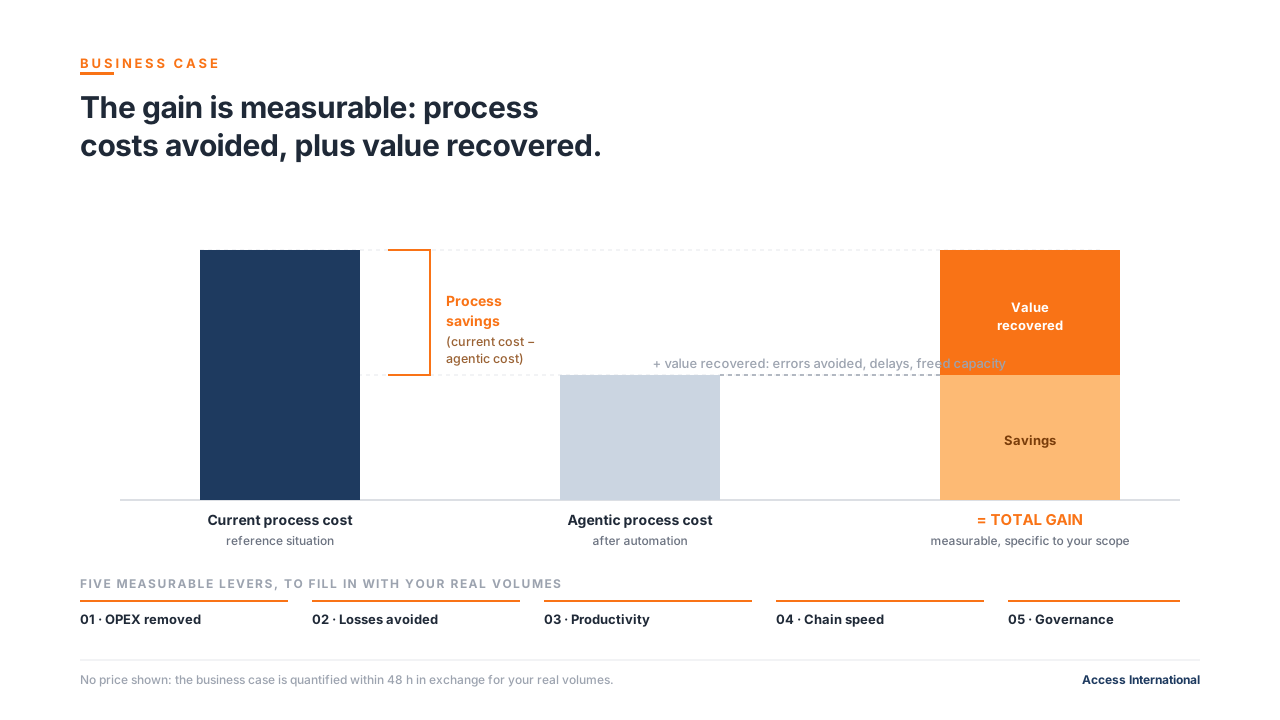
Business case: the gain formula
See the ATLAS-Agentic methodology
Frequently asked questions

AI orchestration — what leaders ask.

What is the difference between AI orchestration and classic automation?+

Classic automation executes predefined deterministic rules. AI orchestration introduces contextual reasoning at chain steps: one agent decides which source to consult, another verifies factual consistency, a human validates critical outputs. Discipline remains industrial (explicit chain, logging, checkpoints), but each step can adapt its decision to context.

Why MCP rather than a proprietary platform?+

The Model Context Protocol is an open standard that lets any model (Claude, Mistral, OpenAI, open-source models) dialogue with your systems through a unified interface. You avoid vendor lock-in: switching LLMs on a chain step stays a configuration decision, not a migration project.

How do you keep humans in the loop without breaking production cadence?+

The HITL Framework structures three levers: parameterable confidence thresholds (human control only kicks in below a threshold), queue prioritized by criticality, and interface designed for production cadence. At the French telecom operator, the platform processes hundreds of qualifications per day with targeted human intervention on uncertain cases.

What inference cost for an agentic chain in production?+

FinOps governance is part of scoping: automatic low-cost vs premium LLM arbitration based on step criticality, per-execution caps, alerts on overspend. Inference costs are measured per agent and per execution — not opaque. ROI is calculated on the chain, not the LLM alone.

What is the timeline for a first deployment?+

Scoping takes two to three days. The industrialized pilot takes four to eight weeks depending on integration complexity (CRM, data warehouse, business systems). Already-industrialized chains (HITL Framework, think tank Agentic Workflows) can be reused with shorter delays on a new addressable sector.

Do you have a candidate chain to move to agentic orchestration?

Free initial scoping, 30 minutes to 2 hours, with a solution lead adapted to your sector.